
Read the rank first
The queen of hearts, queen of diamonds and queen of spades share a rank. Their suits are different. This is a three-card set under the common definition.
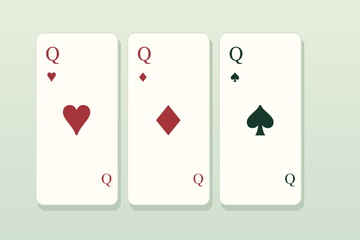
With a standard single deck, there is one card of each suit at each rank. A set can therefore contain three or four cards under common basic rules.
Set or sequence?
| Question | Set | Sequence |
|---|---|---|
| What stays the same? | The rank. | The suit. |
| What changes? | The suit. | The rank, in consecutive order. |
| Simple example | Q♥ Q♦ Q♠ | 4♥ 5♥ 6♥ |
Three face cards are not automatically a set. A jack, queen and king have different ranks. If they share a suit, they can form a sequence under ordinary card ordering.
Repeated suits and multiple decks
Some variants use more than one deck, which introduces identical copies of a card. Do not assume that two copies of the same queen may be used in the same set. The rule for repeated suits needs to be checked separately.
Our illustrations intentionally use different suits, so they do not rely on a multiple-deck exception.
Jokers are a separate rule
Where a game permits wild cards, a joker may stand in for a missing member of a group. The allowed number of substitutions and the treatment of all-joker groups vary.